Selling tips
How to Write Product Descriptions That Sell: Formula, Examples and AI Prompts
Write product descriptions that sell: a simple formula, before-and-after examples for 10 kinds of shops, fill-in templates and AI prompts.
By the WAStore team12 min read
In this guide
- What a good product description actually does
- The anatomy of a product description
- Turn features into benefits
- How to write a product description, step by step
- Product titles that help you sell
- Before-and-after examples for 10 kinds of shops
- Fill-in-the-blank templates
- Writing for WhatsApp and Instagram shoppers
- Product descriptions and SEO
- Using AI to write product descriptions
- Common mistakes to avoid
- A quick checklist before you publish
- Frequently asked questions
A good photo makes someone stop scrolling. A good product description makes them buy. It answers the questions that would otherwise become messages — how big is it? what's it made of? will it arrive by Saturday? — and gives the customer a reason to choose you over the next shop.
The good news: you don't need to be a copywriter. Product descriptions that sell follow a simple, repeatable pattern, and once you have it, each one takes a few minutes. This guide gives you the formula, real before-and-after examples, templates and AI prompts you can use today.
What a good product description actually does
A product description has four jobs, and most weak descriptions only attempt one of them.
- Answer questions. Every unanswered question is a message, a delay, or a lost sale.
- Help the buyer imagine owning it. People buy the experience — the gift being opened, the dress at the wedding — not the item.
- Reduce risk. Clear sizes, materials, care and delivery details make buying from a small shop feel safe, and cut returns.
- Help the right people find it. Descriptive words such as product type, material, occasion and size are also what people type into search engines.
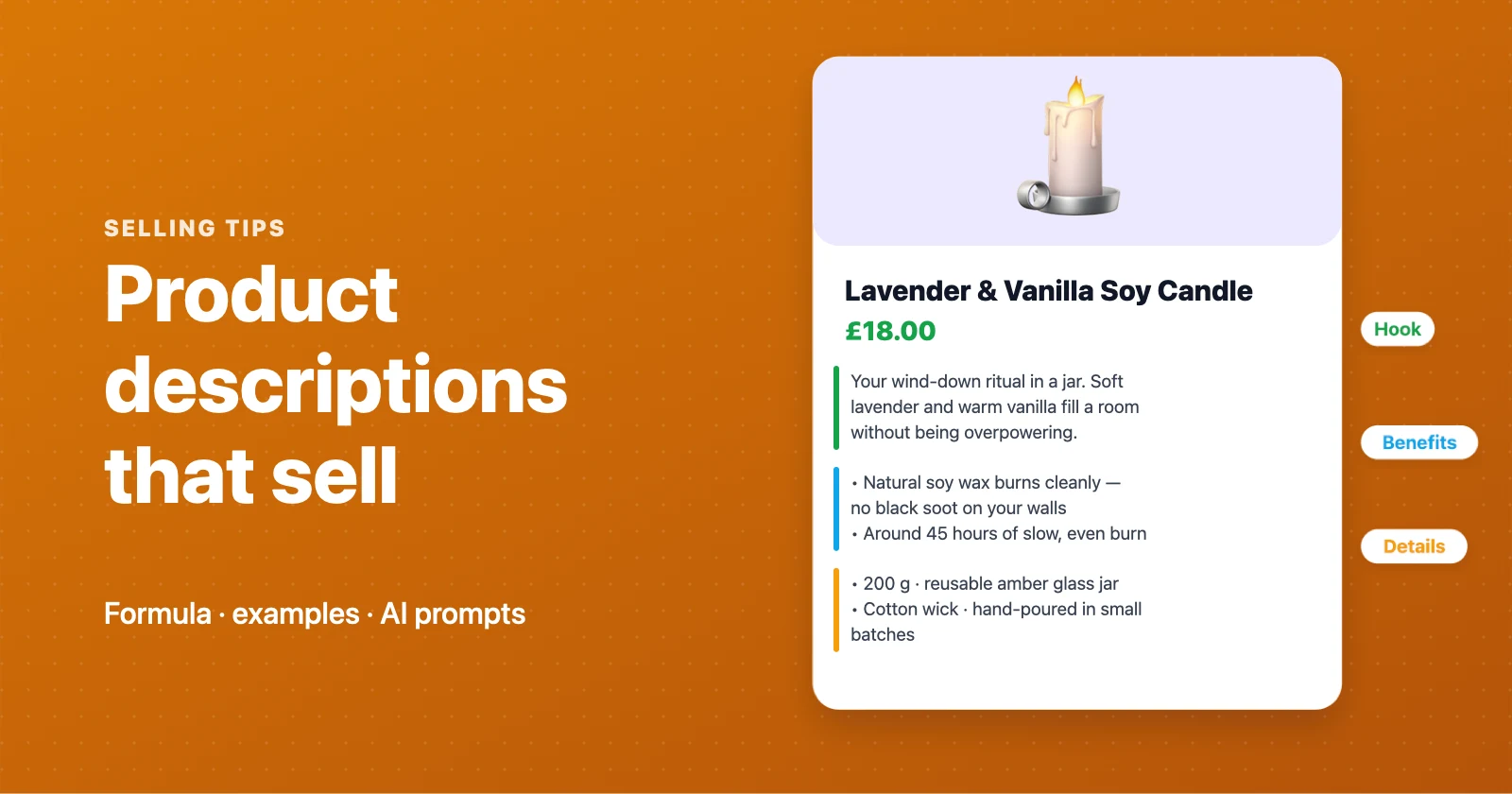
The anatomy of a product description
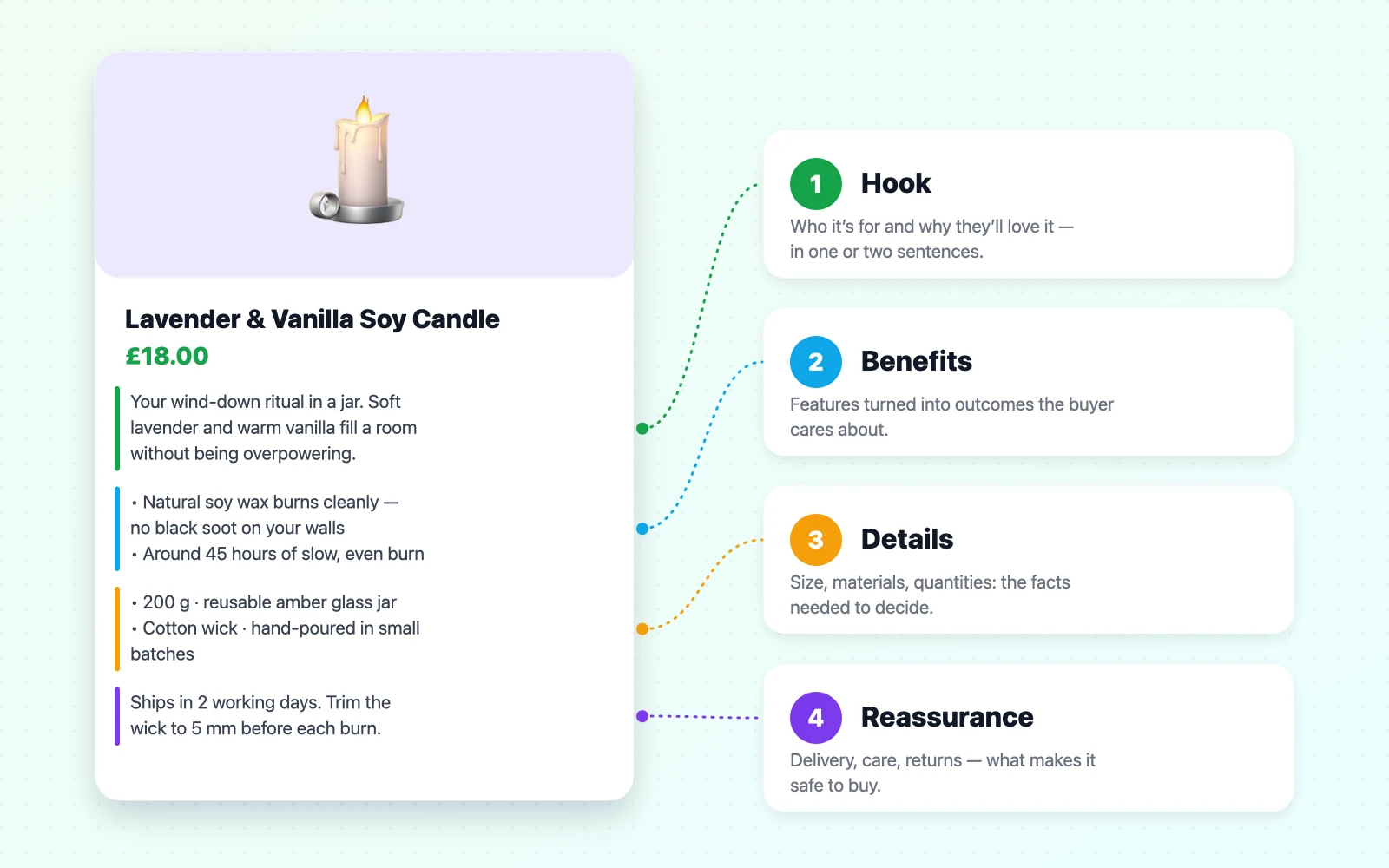
1. The hook (one or two sentences)
Who is it for and why will they love it? This is the line people read before deciding whether to read anything else.
2. The benefits (two to four bullets or sentences)
What does the product do for the buyer? Benefits are features translated into outcomes.
3. The details (bullets)
The facts a buyer needs to decide: size and dimensions, materials or ingredients, colours, what's included, compatibility, weight, allergens.
4. The reassurance (one or two lines)
Delivery time, care instructions, returns, guarantees, or a short customer quote. This is what turns I like it into I'll order it.
Turn features into benefits
A feature is a fact about the product. A benefit is why that fact matters to the buyer. Customers need both — but they buy because of the benefit.
| Feature | Benefit |
|---|---|
| 100% organic cotton | Soft and breathable, so it's comfortable all day — even in summer |
| 925 sterling silver | Won't turn your skin green, and you can wear it every day |
| Soy wax, cotton wick | Burns cleanly for up to 45 hours, with no black soot on your walls |
| Baked to order | Tastes fresh on the day, not like something from a supermarket shelf |
| Ceramic pot with drainage hole | Roots don't sit in water, so your plant is much harder to overwater |
| 20,000 mAh battery | Charges your phone around four times — enough for a long weekend away |
| Hand-stitched leather | Gets softer and better-looking with age, and lasts for years |
A quick trick: after each feature, ask "so what?" and write the answer. That answer is your benefit.
How to write a product description, step by step
1. Picture one buyer. Not "everyone" — a specific person. A mum ordering a birthday cake for Saturday. A 25-year-old buying her first piece of real jewellery. A new plant owner who's killed a plant before. Write to them.
2. List their questions. Write down every question you've ever been asked about this product. Each one needs an answer somewhere in the description.
3. Lead with the strongest benefit. Don't open with the product name or a generic "Introducing our…". Open with the reason to care.
4. Use specific, sensory words. "Delicious" says nothing. "Moist chocolate sponge with a salted caramel centre" makes people hungry. Specifics beat superlatives every time.
5. Use numbers. Sizes, weights, burn time, number of servings, delivery days. Numbers are believable and answer questions instantly.
6. Make it scannable. One short paragraph, then bullets. Most of your customers are reading on a phone, probably with one thumb.
7. Add sizing, fit and care. For clothing and jewellery, sizing is the number one reason for returns. Give measurements and how it fits ("runs small — size up").
8. Match your shop's voice. A playful candle brand and a premium watch dealer shouldn't sound the same. Read it out loud: does it sound like you talking to a customer?
9. Use the words people search for. Name the product type, material, colour and occasion naturally — "silver hoop earrings", not just "Luna".
10. Check it on a phone. Paste it into your store and read it on your phone. Cut anything that doesn't help someone decide.
Product titles that help you sell
The title is part of the description, and often the only part people read in a grid or a search result.
- Say what it is. Luna Silver Hoop Earrings, not just Luna.
- Add the detail that matters most: size, flavour, scent, material or quantity. Chocolate Fudge Cake — 8 inch, serves 12.
- Keep it short enough to read in a grid. Put extra details in the description.
- Be consistent across your shop, so customers can compare products quickly.
Before-and-after examples for 10 kinds of shops
Here's what the formula looks like in practice. Each "before" is the kind of description we see every day; each "after" uses hook, benefits, details and reassurance.
Clothing
Before: Linen shirt. 100% linen. Sizes S–XL.
After: The shirt you'll reach for all summer. Pure linen keeps you cool on hot days and only looks better with a few creases.
- 100% washed linen, soft from the first wear
- Relaxed fit — take your usual size, or size down for a neater look
- Chest (size M): 108 cm · Length: 74 cm
- Machine wash at 30°C, hang to dry
Free exchanges within 14 days if the size isn't right.
Jewellery
Before: Silver hoops. Nice gift.
After: Simple, everyday hoops you'll forget you're wearing — until someone asks where they're from.
- Solid 925 sterling silver, nickel-free and safe for sensitive ears
- 20 mm diameter, 2 mm thick, hinged click closure
- Arrives in a gift box with a polishing cloth
Made by hand in our studio and shipped within 2 working days.
Cakes and bakery
Before: Chocolate cake. Order 2 days before.
After: Our bestselling birthday cake: three layers of moist chocolate sponge, salted caramel filling and a glossy dark chocolate finish.
- 8 inch, serves 12–14
- Personalised message on top at no extra cost
- Contains: gluten, eggs, milk, soy
Baked to order — please order at least 48 hours ahead. Pickup or delivery in [area] on your chosen date.
Candles and home
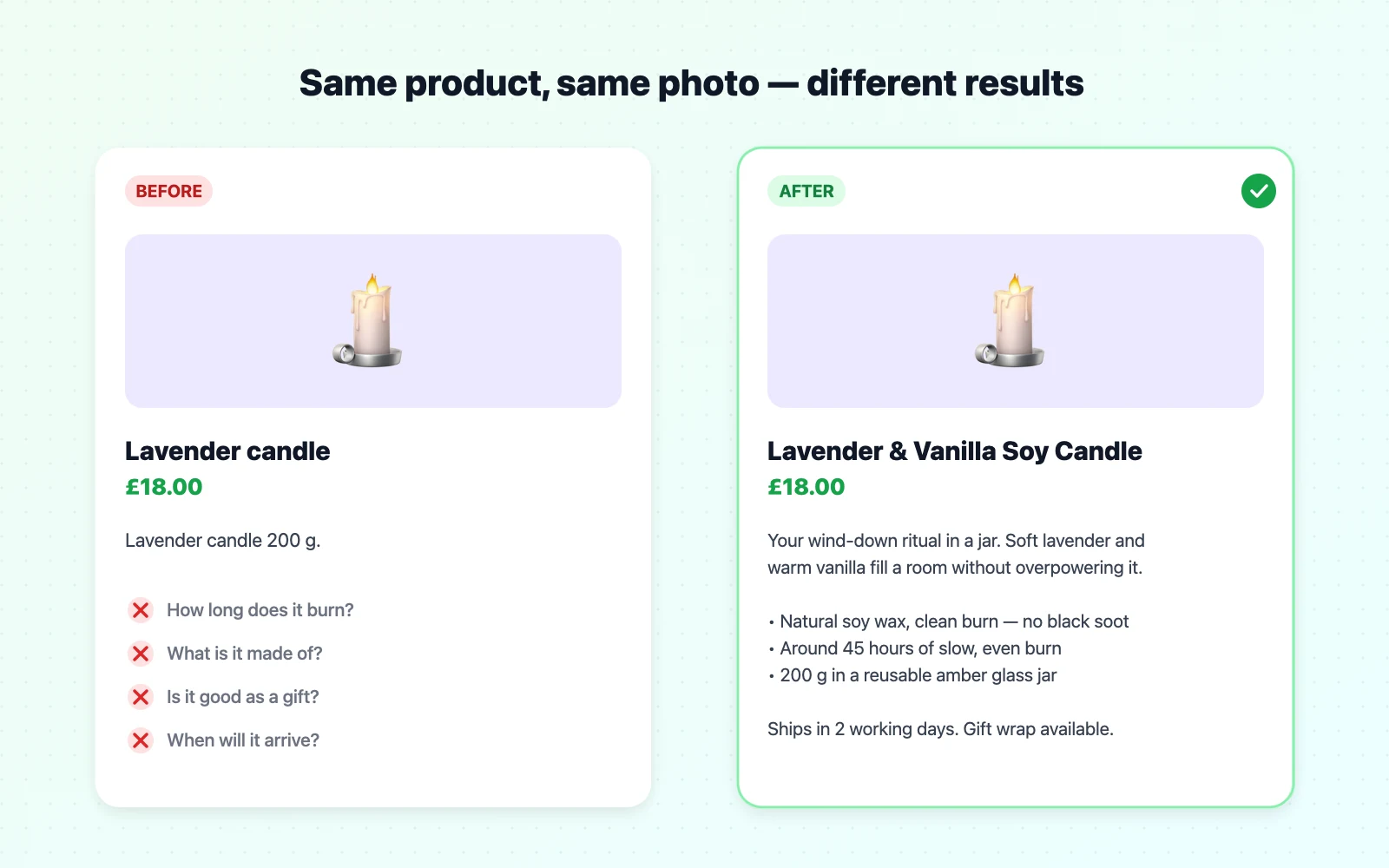
Before: Lavender candle 200 g.
After: Your wind-down ritual in a jar. Soft lavender and warm vanilla fill a living room without being overpowering.
- Natural soy wax with a cotton wick for a clean, even burn
- Around 45 hours of burn time
- 200 g in a reusable amber glass jar
Trim the wick to 5 mm before each burn for the best results.
Beauty and skincare
Before: Face oil 30 ml for all skin types.
After: A lightweight face oil that sinks in fast, so your skin feels soft and calm — not greasy.
- Cold-pressed jojoba and rosehip oils
- Suitable for dry, normal and combination skin
- Fragrance-free · 30 ml with dropper
Use 2–3 drops on clean skin, morning or night. Patch test before first use.
Plants
Before: Monstera in pot. Medium.
After: The easy-going statement plant: big, glossy split leaves that make any corner feel like a holiday.
- Around 60 cm tall, in a 17 cm nursery pot
- Bright, indirect light; water when the top 3 cm of soil is dry
- Comes with a care card and our message-us-anytime plant help
Local delivery on Saturdays, carefully wrapped so it arrives happy.
Food and drinks
Before: Coffee beans 250 g.
After: A smooth, chocolatey espresso blend that's forgiving enough for a home machine or a moka pot.
- Tasting notes: cocoa, toasted hazelnut, caramel
- Roasted every Monday — beans ship within 3 days of roasting
- 250 g whole beans, or ground for your brewer
Not sure which grind? Message us and we'll help.
Handmade crafts
Before: Handmade tote bag, canvas.
After: A tote that actually holds your laptop, lunch and a water bottle — and looks good doing it.
- Heavy 12 oz cotton canvas, double-stitched handles
- 40 × 38 × 10 cm with an inside zip pocket
- Hand-printed, so every bag is slightly different
Spot clean or cold hand wash. Ships in recycled packaging.
Electronics accessories
Before: Power bank 20000mAh black.
After: Never watch your battery drop to 1% again. Charges a typical phone around four times on a full charge.
- 20,000 mAh with 20 W fast charging over USB-C
- Charges two devices at once
- Airline-friendly, 360 g
12-month warranty. Cable included.
Services
Before: Gel manicure 35.
After: A glossy gel manicure that stays chip-free for up to three weeks — so your nails still look fresh by the next event.
- Shaping, cuticle care and your choice of colour
- 60 minutes, in a calm private studio
- Price: [price] · Nail art from [price]
Book a time in a couple of taps and get a confirmation by WhatsApp.
Fill-in-the-blank templates
Use these as a starting point, then rewrite them in your own words.
Physical product
[Hook: who it's for and the main benefit in one sentence.]
• [Benefit 1 — what it does for the buyer]
• [Benefit 2]
• [Key details: size / materials / what's included]
• [Care, compatibility or allergens]
[Reassurance: delivery time, returns, guarantee or a short review.]
Food made to order
[Flavour hook in one mouth-watering sentence.]
• Serves [number] · Size [size]
• [Key ingredients] · Contains: [allergens]
• Order [time] ahead · [Pickup / delivery details]
Service
[The result the client gets, in one sentence.]
• What's included: [list]
• Duration: [time] · Price: [price]
• How to book: [steps]
Writing for WhatsApp and Instagram shoppers
If customers find you on social media and order by chat, a few extra rules apply.
- Put the price where people can see it. Hiding prices behind "message us" adds a step and loses impatient buyers.
- Front-load the first line. Previews and product cards often show only the first sentence or two.
- Keep emojis functional. One emoji per line to mark sections (📏 size, 🚚 delivery) helps scanning. A row of sparkles doesn't.
- Answer the chat questions in the description. If people keep asking "does it come in blue?", the answer belongs in the description.
- Link, don't retype. Once descriptions live in your store, reply to "tell me more" with the product link.
On WAStore, each product has its own page with photos, price, description and an add-to-cart button, and customers send their full order to your WhatsApp — so a strong description does the selling while you're busy.
Product descriptions and SEO
You don't need to be an SEO expert to write descriptions that search engines like.
- Write unique text. Copying the manufacturer's description means competing with every other shop that did the same.
- Use natural keywords. Say what the product is the way customers would: "handmade soy candle", "8 inch birthday cake", "925 silver hoop earrings".
- Write descriptive titles. They're the strongest signal for what a page is about.
- Describe your images. Alt text like "silver hoop earrings worn by a woman with short hair" helps search engines and visually impaired customers.
- Don't stuff keywords. Repeating the same phrase five times reads badly and doesn't help.
Using AI to write product descriptions
AI tools are very good at the first draft. They're not good at knowing your product, so you're still the editor.
Give it the facts. The more specific the input — materials, sizes, who it's for, your tone — the better the draft. These prompts work well in any AI assistant:
Write a product description for [product] for my small online shop.
Audience: [who buys it]. Tone: [warm / playful / premium].
Facts: [materials, size, quantity, what's included, care].
Structure: a one-sentence hook, 3–4 benefit bullets, a details
line, and a reassurance line about [delivery / returns].
Under 120 words. Don't invent facts.
Rewrite this product description so it's easier to scan on a phone,
leads with the main benefit and keeps every fact unchanged:
[paste description]
Suggest 5 product titles for [product] that say what it is,
include [material / size / flavour], and are under 60 characters.
Translate this product description into [language] for customers
in [country]. Keep it natural, keep the measurements and prices,
and adapt any idioms: [paste description]
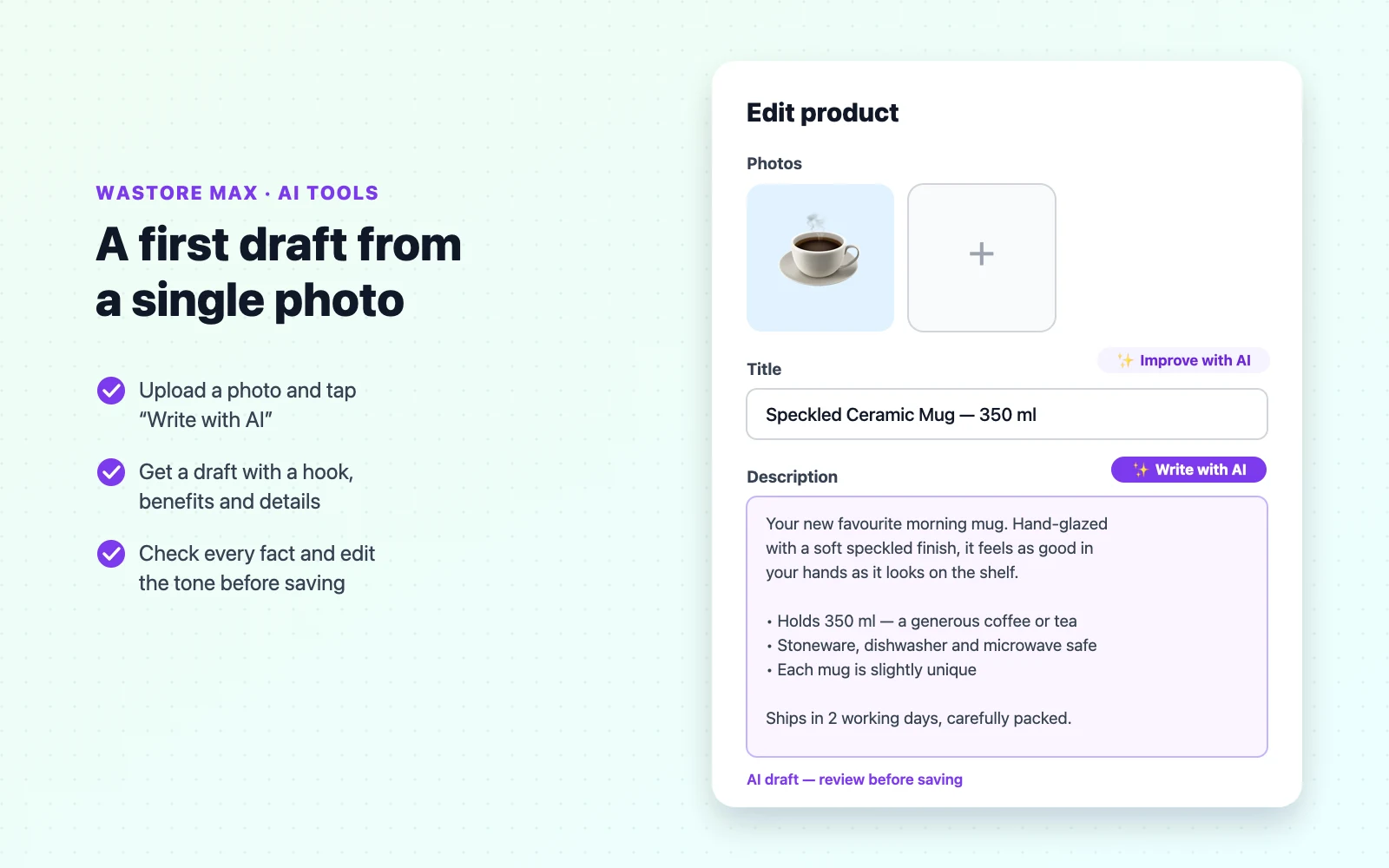
Always check the output. AI sometimes invents details — a material you don't use, a size that's wrong, a guarantee you don't offer. Read every line against the real product.
Common mistakes to avoid
- Only listing features. "Cotton, size M, blue" tells people what it is, not why they'd want it.
- Generic praise. "High quality", "amazing" and "best ever" are invisible. Show the quality with specifics instead.
- Walls of text. Nobody reads a 300-word paragraph on a phone.
- Missing sizes or measurements. The most common cause of messages and returns.
- Copy-pasted descriptions across similar products. Each product deserves at least one unique line.
- Spelling mistakes. They make a shop look careless. Read it once more before you publish.
- Forgetting the practical stuff. Delivery time, allergens, care and returns are what make a cautious buyer comfortable.
A quick checklist before you publish
- Does the first sentence say who it's for and why they'll love it?
- Have you turned each key feature into a benefit?
- Are sizes, materials, quantities and other specifics included?
- Could a customer order without messaging you first?
- Is it easy to scan on a phone?
- Does the title say what the product is?
- Does it sound like your shop?
Good descriptions are one of the cheapest ways to sell more: you write them once, and they work on every visitor, every day. Start with your three bestsellers, rewrite them with the formula above, and watch how many fewer "how much / what size / when can I get it?" messages you get.
Want a shop to put them in? Create a free WhatsApp store — add products with photos, prices and descriptions, share one link, and receive complete orders in WhatsApp.
Frequently asked questions
How long should a product description be?
Long enough to answer a buyer's questions and no longer. For most small-shop products that's 50 to 150 words: a one- or two-sentence hook, three to five benefit or detail bullets, and practical information like size, materials and delivery. Complex or expensive products can justify more.
What should a product description include?
Who the product is for, the main benefit, the key details (size, materials, ingredients, compatibility), what makes it different, and practical information such as care instructions, delivery time or what's in the box. Social proof, like a short customer quote, helps too.
What is the formula for a good product description?
A simple formula is hook, benefits, details, reassurance. Open with who it's for and why they'll love it, turn features into benefits, list the specifics a buyer needs to decide, and end with something that reduces risk, such as delivery time, returns or care information.
Can I copy the manufacturer's product description?
You can, but you shouldn't. Hundreds of other shops use the same text, so it won't help you stand out or rank in search, and it's rarely written for your customers. Rewrite it in your own words and add what you know from handling the product.
Should I use AI to write product descriptions?
AI is a great way to get a first draft quickly, especially from a photo and a few facts. Always check the result: correct any invented details, make sure measurements and materials are right, and edit the tone so it sounds like your shop.
How do product descriptions help SEO?
Unique descriptions that use the words customers search for, such as the product type, material, size or occasion, help search engines understand and rank your product pages. Descriptive titles and image alt text help too.
Should product descriptions use bullet points?
Yes, for details. Most shoppers scan on a phone, so short bullet points for sizes, materials and features are easier to read than a long paragraph. Keep a sentence or two of normal text at the top to set the scene.
How do I write descriptions for many products quickly?
Write one template per category, with the same structure and blanks for the details, then fill it in for each product. A spreadsheet and CSV import, or an AI tool that drafts descriptions from photos, can speed this up further.
Build a free WhatsApp store in about 90 seconds
Catalog, cart and WhatsApp orders — free for up to 50 products.
Get started